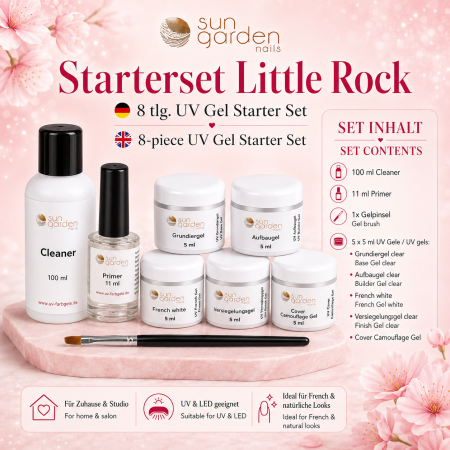
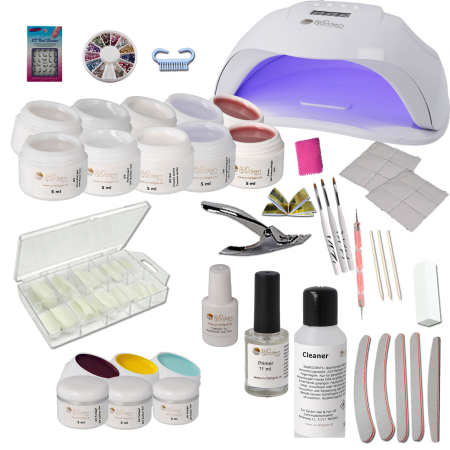
Before you start with your first nail modelling, you should set up your workstation so that you have all the utensils to hand. Make sure there is sufficient lighting at your workstation, possibly with an additional work light. UV light curing device, UV gels, files, buffers, cell tips, tip box, tip glue, cutter, brush, cleaner, dust brush, nail oil and possibly all nail art products such as stamp set, glitter powder, rhinestones, etc. should be at hand.
-
Wash your hands thoroughly and dry them well before starting. Remove any nail polish from your nails.
-
Carefully loosen the cuticles with a spatula or rosewood stick (wide side, not the tip) and push them back.
-
Shorten fingernails with a file and file into an oval shape (natural nail should be shortened so that max. 2 mm protrude).
-
Carefully roughen the natural nail with a file or buffer until there is no more shine on the nail. Remove all dust from the nail with a nail brush or dust brush. Please ensure that you no longer touch the roughened nail with your bare fingers.
-
Determine tip size. Please ensure that the tip notch fits exactly on the natural nail. The tips should be exactly flush with the sides of the nail. It is better to use a larger tip and file it slightly narrower on the sides than a tip that is too small.
-
Now stick the tip on with the tip adhesive. Apply the tip adhesive to the tip notch.
-
Note: Then hold the tip downwards so that the tip glue does not run onto the entire tip or onto your fingers. The tip must now be placed with the notch on the fingernail so that the notch is directly flush with the natural nail. Make sure that no air bubbles form under the tip adhesive surface. If this happens, carefully file the tip down again. (use a tip remover if necessary)
-
Determine the length of the nails, shorten the tips with the cutter and file them into the desired shape.
-
Carefully file and roughen the tip until it is no longer shiny. File the transition between the tip and the natural nail until it is no longer visible. Then remove all dust from the nail with a nail brush or dust brush. Again, please ensure that you no longer touch the roughened nail with your fingers.
-
The next step is to apply the primer. Please apply primer sparingly to the natural nail and allow to dry briefly. Please ensure that the primer does not come into contact with the cuticles.
-
Now apply the 1st layer (use UV bonding gel or UV 1-phase gel)
-
Apply a thin layer of UV base gel or 1-phase gel to the entire nail using the gel brush. Please ensure that nothing runs into the edge of the nail. If gel does run into the edge of the nail, carefully remove the gel from the edge with a rosewood stick (pointed side). For beginners, it is advisable to apply gel to one finger at a time and then cure briefly in the UV light curing unit and then repeat finger by finger. When all fingers are finished, please cure completely for 2 minutes. Now repeat the second hand step by step. Important: Do not remove the sweat layer! For French tips, please read the instructions for French nails
-
After curing, apply the second layer with the UV build-up gel or 1-phase gel. Using the gel brush, apply a small amount directly to the centre of the nail and spread it out with the gel brush without applying pressure so that you achieve a beautifully curved nail shape. The highest point should be in the centre of the nail. Please make sure that nothing runs into the edge of the nail. It is also advisable for beginners to apply gel to one finger at a time and then cure briefly in the UV light curing device and then repeat finger by finger. When all fingers are finished, please cure completely for 2 minutes.
-
Now carefully remove the sweat layer! Moisten a cloth with cleaner and carefully wipe off the layer of sweat so that there are no sticky spots left. Now repeat the second hand step by step.
-
Now file the nail plate with the file (fine-grained side) and smooth out any unevenness to create the desired nail shape. Then matt the nail with the buffer and remove any traces of filing. The nail should no longer be shiny.
-
For the third and final coat, apply the sealing gel. Apply a thin layer of sealing gel from the edge of the nail bed to the tip of the nail. Please ensure that nothing runs into the edge of the nail. Here too, it is recommended for beginners to work finger by finger. Then cure all fingers for 2 minutes.
-
This also creates a layer of condensation, which should also be carefully removed.
-
Now check the sides of the nails for gel residue and carefully file it away if necessary.
-
Apply a little nail oil to the cuticles and massage in.
Instructions for French nails:
Apply a thin layer of the selected French or colour gel to the tip of the nail (it does not have to be opaque) and cure for 15 - 20 seconds. Now apply the second French or colour layer to create a beautiful white or coloured French tip. Please do not remove the sweat layer, but continue working from step 14.
Natural nail reinforcement:
If you do not want to lengthen your fingernails (without nail tips), but only reinforce them, then steps 5-8 are not necessary. Proceed as described for all other steps.
Filling the nail modelling:
When filling the gel nails, first file the transition of the full-grown gel nail flat and remove any lifting, then carefully file off any colour, French or pattern and then continue from step 9.
Notes:
UV gels must always be cured in a UV light curing unit. Between the various work steps, always ensure that the gel jars are not placed directly next to the light curing unit, as they will otherwise harden in the jar. Make sure that no sunlight shines into the rooms or onto the workstation. Furthermore, do not work outdoors.